Important work ages in the background while urgent noise fills every hour. To stop this, organisations must move beyond static frameworks—the 'pillars'—and adopt a kinetic operating system that governs how work is filtered, orchestrated, and dispatched across a hybrid workforce of humans and autonomous agents.
The Identity Gap: Agent Security's Missing Layer
Agents can hold wallets, execute payments, and submit documents - they just can't prove who they are. W3C DIDs and Verifiable Credentials fill the gap. The window to build this layer openly, before platform-specific alternatives calcify, is now.
Published agentic AI stack architectures — five-layer, seven-layer, and nine-layer frameworks in common circulation, alongside Microsoft's own agentic AI roadmap reviewed as of April 2026 — cover compute, models, orchestration, tooling, and observability. None include trust as a named layer. Agents can hold wallets, execute payments, and submit documents - they just can't prove who they are. This paper examines why the identity layer is missing from agent runtimes, how existing standards (W3C DIDs, Verifiable Credentials) can fill the gap, and why the window to build it openly is now.
Trust Management for Agent Operations
Risk management is a mature discipline. Trust has been implicit - embedded in qualifications, regulation, and human accountability. Agents break every one of those assumptions. Trust management makes the implicit explicit: what signals does this interaction require, what signals are present, and is the gap acceptable for the risk level of the action?
Every governance framework in use today embeds trust assumptions calibrated on decades of human behaviour. Agents break those assumptions. This paper argues that trust management - the explicit identification, assessment, and governance of trust signals - needs to become a discipline in its own right, with registers, scoring, thresholds, and continuous monitoring, paralleling how organisations already manage risk.
en-quire: Governed Markdown Editing for Agent Systems
An MCP server for agents to read, search, and surgically edit markdown docs — with RBAC and git-native approval.
Agents that manage documentation need more than file access — they need structure, governance, and the ability to edit precisely without reading everything. en-quire gives them that: section-level editing, searchable document structure, and git-native approval workflows, all without imposing a schema on your markdown.
The Creative Operations Stack
AI can do the work. Knowing what to work on, when it's done, and whether it matters — that's the hard part. 14 weeks of measurement, three frameworks, preliminary results.
In a 14-week single-studio pilot, decision latency fell by roughly 68% and no projects went unreviewed. Three integrated frameworks for managing AI-augmented creative work.
Campaign Framework for Creative Studios
Three tiers (Campaigns → Content Briefs → Production Outputs) bridge strategy to execution. One anchor piece generates multiple platform adaptations. Resource visibility before commitment, not after overload.
A three-tier system for planning and executing marketing campaigns. Maintains narrative coherence across platforms while enabling parallel production and resource visibility. Developed internally, tested over two months.
The Purpose Gap
Every task should trace back to a strategic outcome. Without this golden thread, you're busy but not building. The missing layer is outcome-driven initiative governance.
Tasks without strategic lineage often fail silently. When daily work can't trace back to outcomes, studios tend to optimize for motion instead of progress—shipping content that compounds nothing.
Strategic Outcomes Framework
Four layers—Value Streams, Strategic Outcomes, Initiatives, Tasks—with explicit linkage create the 'golden thread' that traces any daily task back to strategic purpose.
A four-layer hierarchy connecting daily tasks to strategic purpose. Value Streams organize the portfolio, Strategic Outcomes define success, Initiatives bound the programs, and Tasks do the work—with explicit linkage at every level.
Bandit Scoring for Task Prioritization
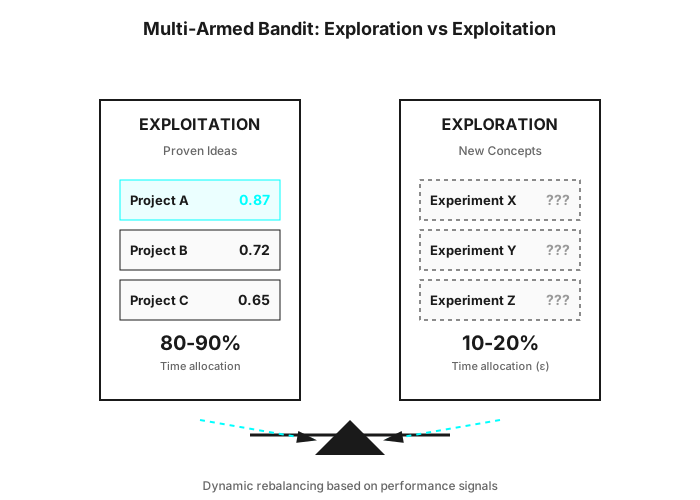
Allocate creative attention using simple indices that balance exploitation of proven ideas with exploration of new concepts. Score tasks 0-22 based on Revenue, Portfolio Value, Engagement, and Exploration—then pick the highest score 90% of the time.
A practical heuristic for allocating creative attention across competing projects, inspired by multi-armed bandit theory. This is not a formal reinforcement learning implementation—it's a pragmatic decision framework that balances exploitation of proven ideas with exploration of new concepts.
The Campaign Coherence Problem
Individual posts succeed while campaigns fail because nothing connects daily content to quarterly goals. The missing layer is campaign-level governance.
Marketing campaigns fragment when strategy lives in one system and execution in another. The gap between 'why we post' and 'what we post' creates drift, wasted effort, and content that compounds nothing.
Governance Protocols for AI-Delegated Work
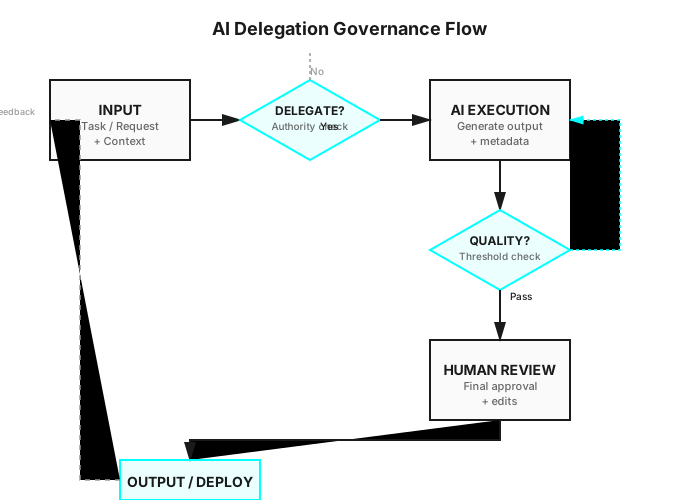
Explicit decision boundaries, three-gate closures, and restart protocols enable AI delegation without losing quality or control.
Operational protocols for delegating creative and operational work to AI agents. Decision boundaries, quality gates, restart protocols, and the three-gate closure system—developed through 8 weeks of internal pilot use at NullProof Studio.
The Multi-Clock Problem
Creative work operates on three distinct rhythms (daily, weekly, monthly)—forcing everything onto one calendar creates decision latency and kills both deep work and incubation.
Creative studios often struggle when all work runs on one rhythm. Multi-clock work separates daily shipping, weekly strategy, and monthly dormant review so ideas can mature without chaos.
Multi-Clock Work: A Framework for Creative Studio Operations
A three-band operating system (HF/LF/Dormant) for creative studios that protects deep work, reduces task starvation risk, and uses Bandit Scores to balance exploitation with exploration. Developed and tested at NullProof Studio.